
The Science Behind Our Technology
Neurosom’s technology is built on the premise that advancing brain health requires a deeper understanding of what happens in the brain during sleep. By combining high-density EEG, AI, individualized brain modeling, and noninvasive neuromodulation, we can characterize sleep physiology with greater precision and explore its connection to cerebrospinal fluid dynamics and the brain’s natural waste-clearance processes.
From Measuring Sleep to Understanding Brain Health
This integrated approach is designed to measure, predict, and ultimately improve brain health.
Built on a track record of successful neurotechnology ventures, Neurosom brings together a team with deep scientific expertise and more than 400 peer-reviewed publications in neuroscience. This foundation of research and innovation drives the development of the Sleep WISP, a next-generation wearable designed to advance personalized sleep therapy.
Beyond Sleep: Measuring the Biology of Brain Health
Neurosom is expanding beyond sleep monitoring to develop proprietary technologies for understanding the underlying biology of brain health. Three new patents awarded in 2026 advance our ability to investigate cerebrospinal fluid (CSF) movement and the brain’s natural waste-clearance processes, opening a new dimension in personalized brain-health assessment.
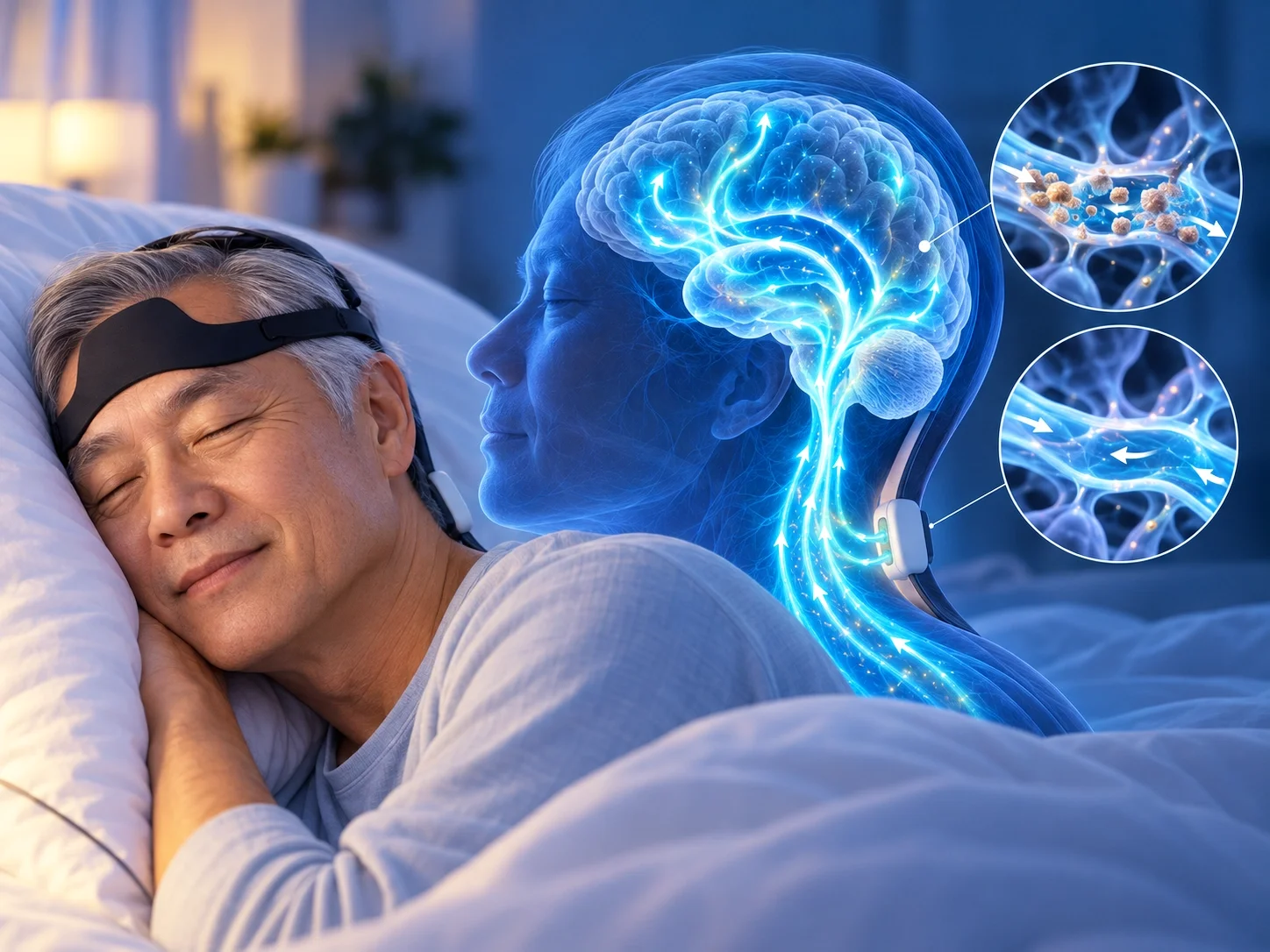
US Patent:
Glymphatic Clearance Capacity Monitoring and Enhancement.
Read Press Release»
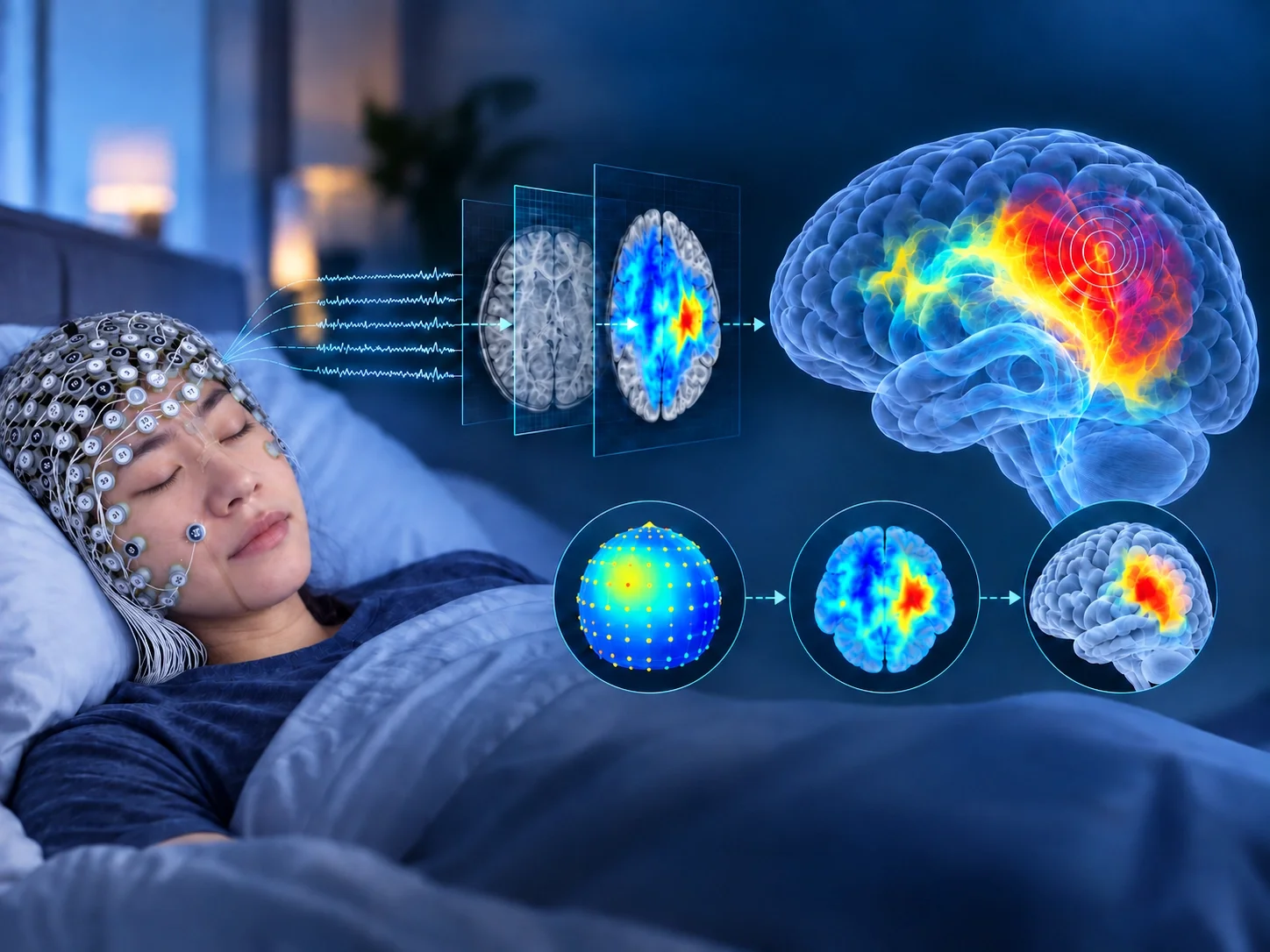
US Patent:
Method for Bayesian Super-Resolution of Electroencephalographic Source Analysis and Transcranial Electrical Stimulation.
Read Press Release»

US Patent:
MRI-Registered Cortico-Hydraulic Digital Twin for Bayesian Super-Resolution Estimation of CSF Flow, Extracellular-Space Dynamics, Neural Source Patterns, and Functional Neuromodulation Targets Using hdEEG and FAST-EIT.
Read Press Release»
Unlike wearable technologies designed to measure a single aspect of sleep, Neurosom is building an integrated platform designed to understand—and ultimately influence—the biology underlying brain health.
Recent Publications
This study challenges the conventional view that the large slow oscillations of deep N3 sleep are widespread waves traveling across the neocortex.
Using 256-channel high-density EEG combined with individual MRI-based head models, researchers mapped the sources of these slow oscillations in 10 healthy adults. The results highlight the important role of limbic networks in the neurophysiology of deep sleep and potentially in memory consolidation.

This study tested whether transcranial electrical stimulation (TES) targeting anterior limbic brain regions could enhance deep N3 sleep.
Thirteen healthy adults underwent overnight EEG recordings with either low-level 0.5 mA TES or sham stimulation. The stimulation was designed to target limbic regions previously identified as important sources of N3 slow oscillations. The findings demonstrate that precisely targeted, low-level electrical stimulation can modulate slow-wave activity and increase deep sleep.

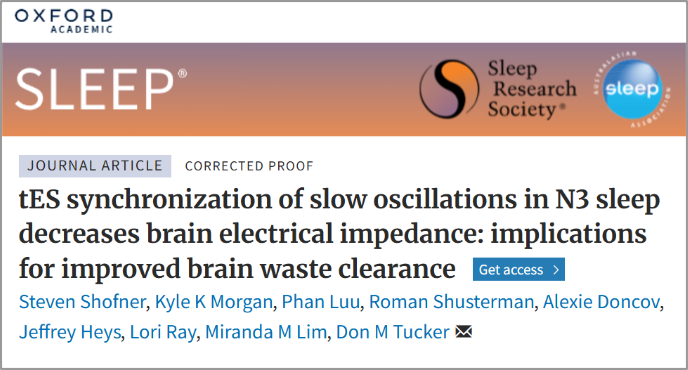
This study investigated whether transcranial electrical stimulation (tES) synchronized with deep N3 sleep can influence brain physiology associated with waste clearance. Researchers measured brain electrical impedance during sleep and found that it decreased relative to wakefulness, with the largest reduction during REM sleep.
The findings provide preliminary evidence linking enhanced slow-wave activity with physiological processes involved in brain waste clearance.
-
This chapter explains how high-density and high-resolution EEG (hdEEG) can provide a much more precise view of sleep neurophysiology by combining dense whole-head electrode sampling with anatomically accurate electrical source localization. The chapter concludes that anatomically accurate high-resolution EEG and source analysis could reveal previously hidden mechanisms of sleep and become increasingly important for understanding memory, emotional regulation, sleep disorders, and brain physiology. Read Full Paper»
-
This review proposes a developmental framework linking early brain formation, neural plasticity, and memory consolidation. The authors trace neural organization from embryonic morphogenesis through fetal activity-dependent synaptogenesis and infant memory development.
Overall, the paper emphasizes continuity between early developmental brain activity, neural plasticity, and later cognitive function. Read Full Article » -
This paper proposes a theoretical model of how the limbic system regulates large-scale cortical networks through two complementary control mechanisms. Overall, the paper suggests that dual limbic control provides a common framework for understanding attention, motivation, memory, cognition, and behavior, with the dorsal system emphasizing internally generated expectations and the ventral system emphasizing environmental constraints. Read the Full Paper»
-
This chapter examines how the brain transforms deliberate learning into rapid, automatic performance, using quarterbacks learning to recognize defensive formations as an example. The authors emphasize that sleep—particularly slow-wave sleep and sleep spindles—is essential for consolidating newly learned skills and memories. They propose that dEEG and fMRI could eventually be used to monitor learning and develop individualized interventions to optimize performance. Read Full Paper»
-
This study evaluated whether high-density EEG (HD-EEG) source imaging can accurately localize the brain region where epileptic seizures begin. The study demonstrates that HD-EEG source imaging can provide a noninvasive, high-resolution method for identifying seizure-onset regions, potentially complementing invasive recordings and helping guide surgical evaluation. Read Full Paper»
-
This study investigated whether slow-pulsed transcranial electrical stimulation (TES) could safely suppress epileptic brain activity in seven adults with drug-resistant epilepsy. The findings provide preliminary evidence that patient-specific HD-EEG source localization combined with focal TES can safely reduce cortical excitability. Read Full Paper»
-
This study investigated how the brain uses multiple memory systems during category learning, and how their involvement changes over time. Overall, the study demonstrates that learning is not dependent on a single memory system; rather, the brain flexibly switches between memory strategies to optimize performance, with these strategies potentially becoming increasingly automatic as expertise develops. Read Full Article»
-
This chapter proposes that human memory, sleep, brain development, and culture co-evolved, with cultural memory playing a central role in shaping individual and social identity. The paper presents sleep-dependent memory consolidation as a potential biological foundation for the evolution of human cognition, cultural transmission, and personal identity, while suggesting that the dissolution of traditional cultural memory may create new challenges for identity in modern society. Read Full Article»
-
This paper proposes the Adaptive Bayes Process Model, a theoretical framework extending predictive coding to explain how motivation and emotion shape unconscious perception, cognition, and behavior. The authors propose that these processes extend into memory consolidation and neural development, providing a unified account of how experience shapes cognition and behavior. Read Full Paper»
-
The review proposes that consciousness emerges from the interaction of implicit and explicit memory systems across the entire brain, rather than from the cerebral cortex alone. The authors suggest that consciousness is a continuous, dynamic process extending from unconscious contextual processing to marginal awareness and explicit focal experience, with arousal and sleep mechanisms playing a fundamental role in organizing this process. Read Full Article»
Other Publications
Posters
Pre-Surgical High-Density EEG and Atlas Electrical Head Models Provide Low-Error Epileptic Foci Predictions in Patients who Received Favorable Resective Surgery - Kyle K. Morgan, Mariano Fernandez-Corazza, Rui Feng, Phan Luu, Mark D. Holmes, and Don M. Tucker
Performance of Optimal Transcranial Electrical Stimulation Limiting the Number of Active Electrodes - Mariano Fernandez-Corazza, Santiago Collavini, Phan Luu, Carlos Muravchik, and Don M. Tucker
Patents
US Patent No. 10, 610,121: Method for Desynchronizing Pathological Neural Oscillations.
US Patent No. 11,045,131: Truncated Icosahedral Neural Sensor Net and Modular Elements.
US Patent No. 19,673,710: MRI-Registered Cortico-Hydraulic Digital Twin for Bayesian Super-Resolution Estimation of CSF Flow, Extracellular-Space Dynamics, Neural Source Patterns, and Functional Neuromodulation Targets Using hdEEG and FAST-EIT.
US Patent No. 12,663,866: Method for Bayesian Super-Resolution of Electroencephalographic Source Analysis and Transcranial Electrical Stimulation.